
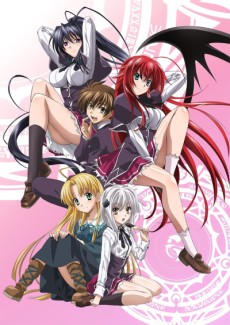
High School DxD
Overview
High School DxD stands as a definitive pillar in the landscape of supernatural action and romantic comedy within the medium. Released in 2012, this 12-episode production serves as a meticulous adaptation of the light novel source material, bringing to life a world where ancient mythological factions clash in a modern high school setting. Produced by Studio TNK, the series debuted during a pivotal era for light novel adaptations, quickly distinguishing itself through its unapologetic blend of high-stakes fantasy and provocative humor.
The narrative focuses on the life of Issei Hyodo, a student at Kuoh Academy whose mundane existence is shattered by a sequence of supernatural events that redefine his identity and purpose. With a status of finished for its initial 12-episode run, the anime offers a complete introductory arc that establishes a complex hierarchy of devils, angels, and fallen angels. Despite its mature themes, the series maintains a rating of 69, reflecting its polarized yet significant standing among critics and viewers who navigate its eclectic mix of genres, including Action, Comedy, Ecchi, Fantasy, and Romance.
As an OniDex featured profile, it is essential to recognize High School DxD not just as a piece of entertainment, but as a cultural phenomenon that redefined how “ecchi” elements could be integrated into a robust, lore-heavy fantasy framework. The 2012 release marked a turning point for Studio TNK, showcasing their ability to handle intricate character designs and fluid combat choreography while maintaining the comedic timing necessary for a harem-style narrative.
Story Summary
The story begins with Issei Hyodo, an ordinary high school student whose primary motivation is driven by his adolescent desires. Issei’s life takes a dark and unexpected turn when he is invited on his first-ever date by a girl named Yuuma Amano. What begins as a dream come true for the perverted teenager quickly descends into a nightmare. At the end of their date, Yuuma reveals her true identity as Raynare, a vicious fallen angel. In a shocking display of violence, she brutally attacks and kills Issei, leaving him to die alone in a park.
However, Issei’s death is not the end. In his final moments, he unintentionally summons Rias Gremory, a beautiful and high-ranking devil from Kuoh Academy. Using a mystical item known as an “Evil Piece,” Rias reincarnates Issei as a devil, making him her loyal servant and a member of her household. When Issei wakes up the next day, he initially believes the encounter was a dream, only to discover a crimson circle on his body and the realization that his humanity has been permanently stripped away.
Now a low-ranking devil, Issei is inducted into the Occult Research Club at his school, which serves as a front for Rias Gremory’s devilish operations. He learns that the world is locked in a cold war between three primary factions: the Devils, the Angels, and the Fallen Angels. Issei’s new life is far from the peaceful harem he envisioned. He must now balance his school responsibilities with his duties as a devil, which include granting wishes for humans and training to survive the lethal attacks of rogue fallen angels and rival supernatural entities.
The 12-episode narrative follows Issei as he discovers his “Sacred Gear,” a powerful weapon manifested from his soul known as the “Boosted Gear.” This weapon grants him the ability to double his power every ten seconds, making him a potential wildcard in the supernatural world. Throughout the season, the plot thickens as Issei attempts to rescue a kind-hearted nun named Asia Argento from the clutches of the fallen angels, leading to a massive confrontation that tests the limits of his new devilish powers and his loyalty to Rias Gremory.
Main Characters
The strength of High School DxD lies in its diverse cast of characters, each representing a different archetype within the fantasy and harem genres.
Issei Hyodo: The protagonist of the series, Issei is a character defined by his transparency. While his perversion is his most prominent trait, it is also his greatest source of power. After being reincarnated as a devil, Issei occupies the rank of “Pawn.” In the devil hierarchy, Pawns have the unique ability to “promote” to other ranks like Queen or Knight when they enter enemy territory. Issei is fiercely loyal to his friends and possesses a surprisingly strong moral compass, specifically when it comes to protecting the women he cares about.
Rias Gremory: As the primary female lead and the master of the Gremory household at Kuoh Academy, Rias is a “King” in the devil ranking system. Known as the “Crimson-Haired Ruin Princess,” she is the sister of the Current Lucifer, making her high-tier royalty. Despite her status and intimidating power, she shows immense kindness to her servants and develops a deep, romantic interest in Issei. Her leadership is the glue that holds the Occult Research Club together.
Akeno Himejima: The vice-president of the club and Rias’s “Queen.” Akeno is a complex character who balances a polite, refined demeanor with a sadistic streak in battle. As a master of lightning and holy power, she is one of the most formidable members of the household. Her relationship with Issei is flirtatious, adding to the romantic tension within the group.
Asia Argento: A former nun who was excommunicated from the Church due to her ability to heal anyone, including devils and fallen angels. After being saved by Issei, she is reincarnated as a devil and joins the Occult Research Club as a “Bishop.” Her innocence and kindness serve as a counterbalance to the more aggressive personalities in the club.
Koneko Toujou: A petite girl who serves as the “Rook.” Despite her small stature, Koneko possesses superhuman strength and serves as the club’s primary physical powerhouse. She initially views Issei with disdain due to his perverted nature, but she gradually grows to respect his determination.
Yuuto Kiba: The club’s “Knight,” Kiba is a handsome and popular student who is a master swordsman. He possesses the Sacred Gear “Sword Birth,” which allows him to create various demonic swords. Kiba serves as a brotherly figure to Issei, providing a rare male friendship in the harem-heavy environment.
Episode Information
The first season of High School DxD consists of 12 episodes, which were aired in 2012. This episode count is utilized to cover the first two volumes of the light novel source material. The pacing is deliberate, allowing for world-building in the early stages while ramping up the action in the latter half.
The 12-episode structure is divided into two major story arcs. The first arc focuses on Issei’s transition into devilhood and the rescue of Asia Argento. This arc is essential for establishing the stakes of the series, showing that even in a world of comedy and romance, death and loss are very real threats. The second arc delves into the internal politics of the devil world, specifically focusing on Rias Gremory’s unwanted engagement to Riser Phoenix. This leads to the introduction of “Rating Games,” which are formalized battles between devil households that resemble a supernatural game of chess.
The final episodes of the 12-episode run culminate in a high-stakes battle between Issei and Riser Phoenix. This confrontation is significant because it marks Issei’s growth from a weak, terrified human to a warrior capable of sacrificing his own body to achieve a “Balance Breaker” state. The 12th episode provides a satisfying conclusion to the season’s primary conflict while leaving the door open for future developments in the lives of the Occult Research Club members.
Genres and Themes
High School DxD is a multi-faceted work that weaves together several distinct genres.
Action and Fantasy: At its core, the series is a high-fantasy battle story. The integration of “Sacred Gears,” “Evil Pieces,” and the hierarchy of the Three Factions creates a dense lore. The action is not merely window dressing; it is integrated into the character growth. Issei’s power increases not just through training, but through his emotional connections and his desire to protect his new family.
Comedy and Ecchi: The series is well-known for its ecchi elements, which are often used for comedic relief. However, unlike many productions where fanservice feels disconnected from the plot, High School DxD often links Issei’s perverted motivations directly to his combat effectiveness. His “Boosted Gear” responds to his passions, creating a unique synergy between the comedy and the action.
Romance: The romance in High School DxD goes beyond simple harem tropes. While multiple girls are interested in Issei, the central bond between Issei and Rias Gremory is the emotional heart of the series. Their relationship explores themes of belonging, master-servant dynamics, and the blurring of those lines as they fall in love.
Themes of Redemption and Identity: A major theme is the concept of what makes someone “good” or “evil.” Despite being devils, Rias and her household are depicted as honorable and compassionate. Conversely, the “Angels” and “Fallen Angels” are not strictly heroic or villainous. Issei’s journey is one of reclaiming his identity after his humanity is taken away, proving that his soul remains unchanged regardless of his supernatural status.
Production and Studio
Studio TNK was the animation house responsible for bringing High School DxD to life in 2012. At the time, TNK was already recognized for its experience in the ecchi and romance genres, making them a natural fit for this light novel adaptation. Their approach to the production was characterized by a commitment to high-quality character designs that stayed true to the original illustrations by Miyama-Zero.
The animation quality in the 12-episode run is notable for its consistency. During the action sequences, the studio utilized vibrant color palettes to represent various magical powers—Rias’s crimson energy, Akeno’s yellow lightning, and Issei’s green and red Boosted Gear. The use of lighting and shadow helped differentiate the mundane school life from the dark, atmospheric battles that occurred at night or in alternate dimensions.
Studio TNK’s reputation was bolstered by their handling of the mature content. They managed to balance the explicit nature of the ecchi scenes with a high level of artistic detail, ensuring that the series appealed to its target demographic without sacrificing the visual integrity of the action scenes. The 2012 release year was a period when digital animation techniques were becoming more refined, and High School DxD benefited from this, featuring fluid movement and complex background art that helped ground the fantasy elements in a recognizable reality.
Reception and Popularity
Upon its release in 2012, High School DxD became an immediate sensation within the anime community. It achieved a rating of 69, a score that reflects its status as a polarizing yet undeniably successful title. While some critics were skeptical of its heavy reliance on ecchi themes, the broader audience embraced the series for its surprisingly deep lore and engaging characters.
The popularity of the series can be traced to its ability to over-deliver on its promises. Fans who came for the comedy and fanservice were often surprised to find a compelling story about a young man struggling to find his place in a war-torn supernatural world. The “finished” status of the first 12 episodes left fans clamoring for more, as the world-building suggested a much larger universe than what was shown in the initial season.
In terms of cultural impact, High School DxD became a benchmark for the “harem-action” subgenre. It proved that a series could be both provocative and narratively substantial. Its popularity extended beyond Japan, finding a massive international audience through streaming services and home video releases. The 2012 debut solidified the franchise as a commercial powerhouse, leading to various merchandise, spin-offs, and a long-lasting legacy that continues to influence light novel adaptations to this day.
Why Fans Love This Anime
The enduring love for High School DxD stems from its unique “perverted underdog” narrative. Issei Hyodo is not a typical hero; he is flawed, loud, and often driven by the wrong reasons. However, his earnestness and his willingness to die for those he loves make him incredibly relatable to a wide audience. Fans enjoy seeing his progression from a “weakling” Pawn to a character who can stand toe-to-toe with legendary figures.
Another reason for its popularity is the “Evil Pieces” system. This mechanic, inspired by chess, adds a layer of strategic depth to the household dynamics. Fans enjoy analyzing the roles of the Knight, Rook, Bishop, and Queen, and how each character’s personality fits their designated rank. This structured approach to power makes the fantasy elements feel grounded and logical within the context of the story.
Furthermore, the chemistry between the members of the Occult Research Club is a major draw. The series excels at “found family” tropes, showing how a group of outcasts—a reincarnated human, an excommunicated nun, a stoic nekomata, and a traumatized swordsman—can find a home under the leadership of a compassionate devil. The balance of high-stakes battle and quiet, domestic moments at the clubroom creates a rhythmic pacing that keeps viewers invested in the characters’ daily lives.
Final Thoughts
High School DxD remains a landmark release from 2012 that successfully bridged the gap between different anime niches. With its 12 episodes of high-octane action and comedic romance, it provided a blueprint for how to adapt a light novel with passion and precision. Studio TNK’s work on this project ensured that the series would be remembered not just for its ecchi elements, but for its vibrant world and heart-pounding battles.
With a rating of 69, the series stands as a testament to the fact that entertainment value and narrative depth can coexist in a single production. Whether viewed as a fantasy epic about the war between heaven and hell or a comedic look at the life of a reincarnated devil, High School DxD offers a comprehensive and entertaining experience. Its status as finished for this initial season marks the beginning of a larger journey, one that started with a single, unlucky date and evolved into a battle for the very soul of the supernatural world.