Hunter x Hunter (2011)
Overview
Originally released in the autumn of 2011, Hunter x Hunter (2011) stands as a landmark achievement in the landscape of modern Japanese animation. This masterclass of storytelling is a new adaptation of the celebrated manga of the same name by the legendary author Togashi Yoshihiro. Produced by the powerhouse animation studio MADHOUSE, this series is a complete, faithful adaptation that brings the expansive world of Togashi’s imagination to life with unparalleled precision and artistry.
Spanning an impressive 148 episodes, the series holds a prestigious status of FINISHED, offering viewers a complete, beautifully realized narrative journey. With a stellar, near-perfect rating of 89 on OniDex, it is widely recognized by database editors, historians, and casual fans alike as one of the greatest animated works ever produced. Categorized under the major genres of Action, Adventure, and Fantasy, the series uses these traditional narrative frameworks to craft a complex, morally grey, and deeply psychological epic that transcends standard demographic boundaries.
Story Summary
The narrative of Hunter x Hunter (2011) centers around the concept of “Hunters”—elite, licensed individuals who travel the globe to execute highly specialized, incredibly dangerous tasks. These tasks range from capturing notorious international criminals and exploring uncharted, hostile territories to searching deep within ancient ruins for lost historical treasures. To be a Hunter is to possess the ultimate level of social privilege, wealth, and authority, but obtaining and maintaining this status requires traversing trials that routinely claim the lives of the unprepared.
The story begins on the serene, isolated Whale Island, where a young, optimistic boy named Gon Freecss discovers a shocking truth about his lineage. Gon had grown up believing his parents were deceased. However, he learns that his father, Ging Freecss, is actually alive and is recognized as one of the most legendary Hunters in the world. Rather than harboring resentment for being abandoned, Gon becomes deeply fascinated by his father’s choice. He reasons that the profession of a Hunter must be exceptionally grand and meaningful if his father chose it over raising his own son. Driven by a burning desire to understand his father’s world and eventually reunite with him, Gon decides to follow in Ging’s footsteps.
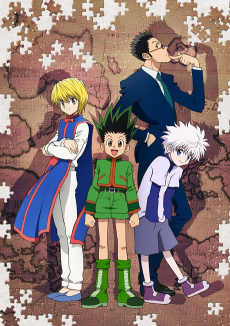
Upon turning 12 years old, Gon leaves his peaceful home to take the notoriously brutal Hunter Exam. The exam is feared worldwide for its incredibly low success rate and high probability of injury or death. It is during this grueling evaluation that Gon’s destiny intersects with three other applicants, each harboring their own distinct, deeply personal motivations:
- Kurapika: The highly intelligent, last remaining survivor of the Kurta Clan, driven by a relentless, consuming desire for revenge against the phantom-like mercenary group that slaughtered his people.
- Leorio Paradinight: A boisterous, seemingly money-obsessed young man who secretly harbors the noble goal of becoming a doctor to provide free medical care to impoverished children.
- Killua Zoldyck: A rebellious, highly skilled 12-year-old who has run away from his family of world-renowned elite assassins, seeking to escape his pre-determined dark fate and find his own purpose in life.
As the exam progresses through a series of deadly psychological and physical trials, these four disparate individuals form an unbreakable bond of friendship. Once the exam concludes, their paths diverge and reunite across several massive story arcs. They navigate dangerous criminal syndicates, participate in lethal underground combat arenas, enter a hazardous virtual reality video game materialized in the physical world, and eventually confront an existential threat to humanity itself. Throughout these monumental trials, their friendship serves as their ultimate emotional anchor in an increasingly hostile and morally complex world.
Main Characters
The brilliance of the character writing in this series lies in the psychological realism, gradual growth, and organic evolution of its central cast. Rather than remaining static archetypes, the main characters are deeply affected by the violence, triumphs, and trauma of their adventures.
Gon Freecss serves as the primary protagonist. On the surface, Gon appears to be the quintessential cheerful, innocent, and determined hero. He possesses an innate connection to nature, sharp senses, and an unshakeable sense of loyalty. However, as the series progresses, Gon’s simplistic, black-and-white moral code is revealed to be highly volatile. He does not judge others by traditional societal standards of good and evil, but rather by how they treat him and his friends. This pure, uncompromising nature makes him incredibly endearing, yet terrifyingly dangerous when pushed to his absolute emotional limits, leading to some of the most intense psychological developments in the history of the medium.
Killua Zoldyck acts as Gon’s best friend and narrative foil. Trained from infancy in the brutal art of assassination, Killua possesses superhuman physical capabilities, a high tolerance for torture, and a cold, analytical mind. Despite his lethal upbringing, Killua is a deeply sensitive child who desperately craves normalcy and companionship. His friendship with Gon becomes the catalyst for his redemption, as he struggles to overcome the psychological conditioning and manipulation of his family. Killua’s journey is one of self-discovery, transitioning from a weapon of death into a fiercely protective, compassionate individual.
Kurapika represents the tragic, vengeful side of the narrative. Cool, collected, and exceptionally intellectual, Kurapika’s entire existence is defined by the trauma of his past. The criminal organization known as the Phantom Troupe slaughtered his entire clan to harvest their rare, glowing scarlet eyes, which fetch a fortune on the black market. Kurapika’s pursuit of justice quickly transforms into an obsessive quest for vengeance. He willingly places deadly restrictions on his own life force to obtain the specialized powers necessary to destroy his enemies, making his storyline a gripping study of the destructive cost of revenge.
Leorio Paradinight is the emotional heart and grounding force of the group. While he initially presents himself as a cynical, materialistic individual who only desires the wealth associated with a Hunter license, his true nature is incredibly compassionate. After losing his childhood friend to a curable disease due to a lack of money for treatment, Leorio swore to become a doctor who never charges those in need. Although he lacks the supernatural combat prodigy of Gon, Killua, and Kurapika, Leorio’s loyalty, emotional intelligence, and humanity often act as the vital glue holding the group together during their darkest moments.
Episode Information
With a robust count of 148 episodes, Hunter x Hunter (2011) stands as a monument of narrative pacing and structural integrity. Unlike many long-running television adaptations of popular manga, which often suffer from extensive, non-canonical “filler” episodes to allow the print source material to stay ahead, this series maintains a remarkably tight, filler-free adaptation rate.
The 148 episodes are divided into several distinct, highly cohesive story arcs that completely shift the tone, setting, and sub-genre of the series. The show begins with the lighthearted yet dangerous Hunter Exam Arc, transitions into the rescue-oriented Zoldyck Family Arc, moves to the martial-arts-focused Heavens Arena Arc, plunges into the dark, urban-noir thriller of the Yorknew City Arc, enters the strategic, card-based fantasy of the Greed Island Arc, culminates in the massive, philosophical horror of the Chimera Ant Arc, and concludes with the political intrigue of the Hunter Chairman Election Arc. This diverse structure ensures that the series never feels stagnant, as each arc offers a completely fresh artistic and narrative experience within the 148-episode run.
Genres and Themes
The series is classified under three primary genres: Action, Adventure, and Fantasy. However, the production team at MADHOUSE and the original creator, Togashi Yoshihiro, use these genres as vehicles to explore deeply sophisticated, mature thematic elements.
Within the realm of Action, the series rejects the concept of fights being decided simply by who has the greater raw power or emotional outburst. Instead, the action is defined by strategy, psychological warfare, and a highly logical supernatural energy system. Every battle is a high-stakes chess match where intellect, preparation, and understanding of one’s limitations are the keys to survival.
As an Adventure, the series captures a genuine sense of wonder and terror. The world of Hunters is vast, dangerous, and uncaring. The characters do not travel along a safe, pre-determined heroic path; instead, they are forced to adapt to a world that features sovereign nations, lawless slums, hidden magical biomes, and complex political landscapes. The fantasy elements are deeply integrated into the world’s biology and ecology, making the supernatural feel tangible and grounded.
Thematically, the series explores several profound concepts:
- The Duality of Human Nature: The narrative constantly blurs the lines between humanity and monstrosity. It showcases how monsters can develop profound empathy, love, and artistic appreciation, while humans can sink to unimaginable depths of cruelty, malice, and systemic violence when threatened.
- The Cost of Ambition and Obsession: Whether it is Gon’s single-minded pursuit of his father or Kurapika’s quest for vengeance, the series illustrates that absolute dedication to a single goal requires sacrificing one’s innocence, physical well-being, and peace of mind.
- The Power and Fragility of Youth: Through Gon and Killua, the story examines the burden placed on children forced to grow up too quickly in a violent world, highlighting the precious, protective nature of their mutual companionship.
Production and Studio
The visual and auditory execution of Hunter x Hunter (2011) is a testament to the legendary reputation of studio MADHOUSE. Known historically for producing some of the most visually stunning, stylistically distinct, and critically acclaimed projects in the industry, MADHOUSE brought their absolute best talent to this massive undertaking.
The animation quality across all 148 episodes is remarkably consistent, an incredibly rare feat for a long-running, weekly television series. Rather than relying on static images or shortcuts, MADHOUSE delivered fluid, dynamic character movement and incredibly choreographed action sequences. The studio’s art direction masterfully shifts the visual tone of the series to match the narrative; the bright, vibrant color palette of the early episodes gradually darkens, culminating in a heavy, shadow-draped, cinematic visual style during the high-stakes, dramatic arcs of the second half.
In addition to the stellar animation, the production is elevated by an exceptional orchestral musical score composed by Hirano Yoshihisa. The soundtrack seamlessly transitions from sweeping, whimsical adventure themes to tense, psychological arrangements and grand, tragic operatic pieces. Combined with top-tier voice acting performances that bring immense psychological depth to the characters, MADHOUSE’s production values set a gold standard for long-form television animation.
Reception and Popularity
Upon its debut in 2011, the series was met with critical acclaim that only intensified as the story progressed. Its rating of 89 on OniDex reflects its standing as a universally beloved masterpiece. It holds a permanent place at the very top of global anime database rankings, celebrated by historians and critics as a pinnacle of narrative adaptation.
The fan reception for this series is characterized by deep analytical respect. Unlike many action-adventure series that are enjoyed purely for entertainment, Hunter x Hunter (2011) is frequently the subject of academic-style essays, character studies, and deep thematic analyses within the fan community. Its popularity is global, bridging the gap between mainstream viewers who appreciate its high-octane action and critical viewers who admire its intricate plotting, complex power system, and profound psychological deconstructions. Years after its status became FINISHED, it remains a highly discussed, recommended, and re-watched pillar of the medium.
Why Fans Love This Anime
There are several key factors that explain why this series has garnered such passionate, enduring love from its global audience:
First and foremost is the introduction of the series’ supernatural power system. This system is universally praised as one of the most meticulously designed, logical, and balanced magic systems in all of fiction. It operates on strict rules, personal psychological expression, and mathematical trade-offs, ensuring that combat remains intellectually stimulating and entirely unpredictable.
Secondly, fans adore the series’ willingness to subvert traditional expectations. The protagonist does not always win, the main characters are not always present in every arc, and major conflicts are sometimes resolved through political negotiations, tragic sacrifices, or quiet, emotional conversations rather than a physical battle. This defiance of standard formulaic writing keeps viewers in a constant state of suspense and engagement.
Finally, the emotional core of the series—specifically the evolving relationship between Gon and Killua—resonates deeply with audiences. Their friendship is portrayed with an unmatched level of intimacy, nuance, and mutual influence. The joy they experience together, contrasted with the heartbreaking tragedy of their respective psychological struggles, forms an emotional narrative arc that stays with viewers long after the final credits roll.
Final Thoughts
In the vast history of the medium, few series have managed to achieve the level of narrative complexity, structural perfection, and production consistency found in Hunter x Hunter (2011). Studio MADHOUSE took Togashi Yoshihiro’s brilliant manga source material and crafted a 148-episode masterpiece that continues to define the absolute peak of the Action, Adventure, and Fantasy genres.
With its status securely marked as FINISHED and maintaining a monumental rating of 89, this series is not merely a television show; it is an unforgettable, emotionally profound journey through the light and dark facets of the human condition. For any serious enthusiast of sequential storytelling, Hunter x Hunter (2011) remains an absolute, essential masterwork that must be experienced.